Travel to Italy in May with Linda Gold!

Dear Travelers, think spring!
Think about going on a wonderful trip to Italy from May 18 to 26, 2013, led by AAUW Kingston branch member Linda Gold.

amalfi

Make your reservation today! A $50 discount will apply if your deposit is received by February 6, 2013. All deposits are due by February 13, 2013.

For a PDF with all of the info, click here:  Italy_Trip_May2013_AAUW&LindaGold

If you have questions or need more info, contact Linda (845-255-5256, artladyLG@aol.com, specify “Art Tours” in the Subject line) or ViVi (845-331-0155).

Jenn’s Report on the 2013 CTAUN Conference at the UN

Notes from the 2013 CTAUN Conference on Advancing Social Justice

About CTAUN

The Committee on Teaching About the United Nations (CTAUN) held its 14th annual conference at the United Nations Headquarters on January 18. CTAUN was founded in 1996 by Sally Swing Shelley, a senior officer in the UN Department of Public Information (UNDPI), and Barbara M. Walker, an educator at the Washington International School in Washington, D.C. Their mission was to promote education about the United Nations and offer support to educators who teach about the UN.

To advance those goals, CTAUN is partnered with the UNDPI, a UN body devoted to advancing public understanding and awareness of the ideals and work of the UN.  With the help of UNDPI, CTAUN identifies and collects educational materials and resources for educators that will help them better integrate global issues into their teaching. CTAUN maintains a teacher resource center on their website at www.ctaun.org/teacher-resources. In addition to their database of materials, CTAUN holds conferences that are open to educators from around the world to discuss important issues.

This year’s conference, titled “Advancing Social Justice: The Role of Educators,” discussed educators’ responsibility to teach about social injustices around the world and in local communities. In order for the next generation of leaders to achieve greater economic equality and political stability, it is critical for young people to learn about social injustices and understand the socioeconomic mechanisms that cause them. This year’s CTAUN conference aimed to give educators talking points, statistics, and materials to teach their students about the tough and complex issues that underlie social injustices.

Social justice is a topic that involves “overarching dilemmas” and touches on aspects of political, social, economic, environmental, and health policy. In other words, it is a massive, existential subject that could be endlessly discussed. In order to fit the conversation into a single day, CTAUN conference organizers decided to focus primarily on income inequality and human trafficking, two issues at the core of social injustice that impact youths around the globe.

Income Inequality

The morning session delved into income inequality with a keynote address from Thomas Pogge, Leitner Professor of Philosophy and International Affairs at Yale University. Pogge set an urgent tone for the day in his discussion of widening disparities of wealth and income around the world. Most alarmingly, he reported that between 1988 and 2005, the top 5% of income earners went from earning 42.87% of the world’s income to 46.36%. The remaining 95% of earners lost shares of total income. Most dramatically, the bottom quintile lost a third of their take in that period; in 1988 the bottom fifth of wage earners took home 1.16% of the world’s income, by 2005 their share shrunk to 0.78%.  Pogge does not see any simple or easy solutions because the roots of the world’s economic woes are entrenched and multifaceted. Complex networks of economic, political, and social forces act on different international, national, and local levels making it is difficult to effect lasting, positive change.

Following Dr. Pogge’s remarks, Maher Nasser, Director of the Outreach Division of UNDPI, moderated a panel discussion titled, Economic Inequality: Its Global and Local Impacts. The panel analyzed the causes and impacts of economic inequality at international, national, local, and individual levels. Kevin Cassidy, Communications & External Relations Officer for the International Labour Organization (ILO) discussed the changing nature of labor and formal employment arrangements as well as some potential socioeconomic ramifications of new employment structures. He also underscored the importance of developing human capital as a means of sustainable economic and social development. Sister Caroljean Willie, the NGO Representative to the UN for the Sisters of Charity Federation, highlighted the environmental impacts of development and industrialization on economic equality and the disproportionate impact that environmental problems have on poorer citizens. Environmental challenges, such as climate change or water pollution, further erode the poor’s wealth and contribute to losses in income and agency, perpetuating tenuous economic positions and weak standing in society.

Human Trafficking

The morning session firmly established that economic equality, equity of education and opportunity, and social agency are bedrocks for social justice. In the afternoon, CTAUN turned its attention to a situation where the foundation for social justice has gone terribly awry: human trafficking and forced labor. Human trafficking expressly relies on social injustice, for example leveraging the promise of greater economic opportunity, or capitalizing on victims’ relatively weak positions in society, such as being poor, female, or a child.

The afternoon session reconvened with a panel that painted a darkly vivid picture of human trafficking. Piero Bonadeo, Deputy Director of the NY Office of the UN Office On Drugs & Crime (UNODC) moderated Trafficking in Persons: An Ongoing Injustice, a discussion between Kerry Neal, Child Protection Specialist for Juvenile Justice at UNICEF and Desiree M. Suo, Foreign Affairs Officer assigned to the State Department’s Office to Monitor and Combat Trafficking in Persons. Estimates of the number of individuals trafficked into forced labor conditions vary wildly; a 2007 State Department report gave a range of 4 and 27 million people. The difficulty in arriving at a firmer estimate is partly a direct reflection of a lack of social justice and equality, trafficking victims generally come from lower classes of society and/or already “fell through the cracks” before they were trafficked. In addition, the opaque, nebulous, transnational nature of human trafficking makes tracking people and enforcing laws difficult. Only 0.4 percent of victims will ever be identified and, on average, for every 800 trafficked people, only one trafficker will be convicted. The rate of human trafficking has increased over the course of the last decade. The surge is due to a combination of factors, like increased mobility, easier communication, a weak global economy, widening gender gaps in India and China, and crackdowns and increased competition in other illicit trades like drugs and arms.

Trafficked people can end up in a variety of situations, in forced or bonded labor, including militia service; domestic servitude; forced marriage; involuntary organ donation; or exploited in the sex trade. More than 95% of all trafficking victims will be victims of some form of physical or sexual violence and only about 1% will be rescued. At least half the victims of trafficking are minors. The largest share of all trafficked people will end up in the sex trade, and 98% of trafficked sex workers are women and girls. Overall, women and girls account for between 65 and 80% of trafficking victims.

The afternoon keynote speaker, Rachel Lloyd, Founder and CEO of the Girls Educational & Mentoring Services (GEMS) stressed that as frightening and overwhelming as the international statistics may be, most of the time, activists’ energy is best concentrated on small and local actions. Often domestically-born girls and young women in the sex trade are derided as “dirty girls” and much worse, Lloyd suggests there is more empathy for distant, overseas victims who remain more abstract and seem more innocent than the rough-looking 14 year-old girl who lives down the street. Lloyd conceded that storming brothel doors in foreign lands and rescuing young women in the middle of the night seems “more sexy and exciting” than being a mentor to a young person. However, she points out that average people have much more potential to have a direct impact in the latter scenario, plus, there is a largely unaddressed need to stop domestic sex trafficking in the United States. Victims of sex trafficking are usually imagined as foreign, non-English speaking, isolated women and girls, however, the truth is that an overwhelming majority of forced sex workers in the United States are U.S. citizens.

A survivor of sex trafficking herself, Lloyd challenged the audience to extend the same support and understanding to domestic trafficking victims as we do for victims around the world. Domestically, the average age a victim is forced into the sex industry is between 12 and 14 years old. Trafficked around that age, Lloyd says she often wonders what would have happened if a teacher or counselor had shown her a little more positive attention, kindness, or support. The US Department of Justice estimates that at least a quarter of a million youths are in danger of trafficking or sexual exploitation. Most of those kids are runaways, “thrownaways,” and homeless youths, “caught between the child welfare, foster care, and juvenile justice systems.” Between 70 to 90% of them were sexually abused as small children. It frustrates Lloyd that many people –unconsciously or otherwise—view a 13 year-old American-born trafficking victim as somehow responsible for her situation while her  13 year-old peer trafficked abroad is seen as an entirely innocent victim. Lloyd stresses that they are both victims of forces larger and stronger than themselves and neither should be judged or punished for being a victim of her circumstances. Advocates who want to take direct action to against trafficking should work as mentors and advisors, providing supportive environments and open ears to young teens. Lloyd’s organization is founded on that principal, GEMS offers support, education, mentoring, and other services to young women and girls who have been trafficked or sexually exploited.

The conference closed with an address by Somaly Mam, founder of the Somaly Mam Foundation, an organization that aims to end trafficking and modern slavery, involving and empowering survivors in the process. Mam is a survivor of sexual abuse, forced marriage, and sex trafficking in her native county of Cambodia. She escaped Cambodia in 1993 but returned a few years later to found an NGO to aid survivors of sexual exploitation from around Southeast Asia. To conclude the event, Mam and concert pianist, Chloe Flower told Mam’s story through words and music. Flower is releasing her first album soon and a portion of profits will go to the Somaly Mam Foundation.

A detailed report of the conference with links and references will be posted on the CTAUN website in the coming weeks.

                                                     — Jenn Mayfield, International Committee Chair

//

Registration Deadline Extended for the 2013 CTAUN Conference

The registration deadline for the Committee on Teaching about the United Nations (CTAUN) conference has been extended from December 28 to January 7. The conference, titled “Advancing Social Justice: The Role of Educators,” will be held on Friday, 18 January 2013 from 9:00 am to 4:30 pm at the UN Headquarters in Midtown Manhattan (map). The admission fee is $65.00, CTAUN encourages all educators and other interested citizens to attend. Click here to register.

One of the keys to achieving lasting positive change in the world is reaching the youngest generations and to empower a new class of well-informed citizens. The problems facing the world community are incredibly complex and resolving them requires leaders with intelligence and a depth of awareness. Education is paramount to the creation of activists with the knowledge, skills, and empathy needed to tackle the world’s issues.

Accordingly, this year’s conference looks at the role of educators in advancing understanding of social justice issues. CTAUN believes that promoting social justice will foster greater “economic equality and political stability for the world’s citizens,” which is one of the UN’s most central goals. The conference will explore issues of social justice and human security, including human trafficking, forced labor, environmental justice, food security, and immigration/forced migration.

The keynote speakers are Thomas Pogge, author, Director of the Global Justice Program, and Leitner Professor of Philosophy and International Affairs at Yale University, and Rachel Lloyd, founder of Girls Educational and Mentoring Services (GEMS), author, and advocate for trafficked youths. Panel presentations will include representatives from the International Labor Organization (ILO), the UN Office on Drugs and Crime (UNODC), UNICEF (Child Protection), and the US State Department, and other organizations.

For those interested in staying in Manhattan for the weekend, discounted hotel rates are available at ONE UN New York (formerly the Millennium Plaza) for $199 per night for a room with 2 people or $239 per night with 3 occupants. The special rates for conference participants are valid from Wednesday (16th) to Sunday (20th).

If you have any questions, please contact Jennifer Mayfield at jennifer.a.mayfield@gmail.com or 914-388-2937

Celebrate Human Rights Day

The Eleanor Roosevelt Leadership Center at Val-Kill and the United Nations Association, Southern New York State Division (UNA-SNY) are holding an exciting event in honor of Human Rights Day.

“Whose Human Rights?” will be held on Tuesday, December 11, from 11 am to 2 pm at the Henry A. Wallace Center at the FDR Presidential Library and Home in Hyde Park (map).

The featured speaker is Gillian Martin Sorensen, Senior Advisor and National Advocate at the United Nations Foundation. The event will also honor the memory of Margaret K. (Molly) Bruce, a United Nations staff member from the time of its founding in 1945 until 1977, when she retired as one of the highest ranking women in the UN Secretariat.  Ms. Bruce was also a friend and colleague of Eleanor Roosevelt, a human rights activist, and an advocate for women around the world.

Please RSVP as soon as possible to Maureen Benedict at 845-229-5302 or mbenedict@ervk.org.

This is a free event. Coffee and tea will be served, but unfortunately it is too late to order lunch, participants are encouraged to bring a packed lunch. If you have any questions, please contact Jennifer Mayfield at 914-388-2937 or jennifer.a.mayfield@gmail.com.

Symposium on racial profiling and ‘stop and frisk’ policing

The New York City Police Department’s controversial ‘stop and frisk’ policy has brought national attention to policing practices which disproportionately affect people of color. The Sociology Department at SUNY New Paltz would like to invite faculty members, students, and community members to a:

Symposium on racial profiling and ‘stop and frisk’ policing
December 5th, 2012, 4.30pm, SUNY-New Paltz, CSB Auditorium
Reception to follow in CSB 54
 Many AAUW members have joined the community read of the New Jim Crow. This symposium covers an important aspect of  the Jim Crow policies.  Speakers  at the symposium will include:
  • Gabriel Sayegh, the State Director of Drug Policy Alliance, a national organization devoted to ending the War on Drugs.
  • Chino Hardin, a community organizer from the Institute for Juvenile Justice Reform and Alternatives, based in Brooklyn, who have been active in fighting New York’s stop and frisk laws.
  • Alfredo Carrasquillo, an organizer from VOCAL-NY, a statewide grassroots organization which builds power among low-income people affected by HIV/AIDS, the drug war and mass incarceration to create healthy and just communities.
  • Andrew Kossover, the head of the Ulster County Public Defender’s Office, has also agreed to come to the event to speak about the local implications of stop and frisk.
This event is co-sponsored by the Black Studies department, the Latin American and Caribbean Studies Department, the Student Association, the Black Student Union, the SUNY New Paltz Amnesty International chapter, and Students for a Sensible Drug Policy.

Miss Representation Education Committee Meeting

The Miss Representation Education Committee will meet before the open board meeting on December 6, at 3:15 PM at the Kingston Library. All Branch members are more than welcome to attend. We will be discussing ways to bring the movie Miss Representation and its messages into area schools. The movie examines the way women and girls are represented (and under-represented) in our media and the impacts those depictions have on society.

If you have any questions, please contact Jennifer Mayfield at jennifer.a.mayfield@gmail.com or Adele Calcavechhio at adeleacts@gmail.com.

Reminder: Post-Election Analysis Call on Monday, 11/12 at 8 PM EST

AAUW Action Fund
 

You might be wondering: What do the election results mean for AAUW’s priority issues? How will the presidential election results affect our push for pay equity legislation? Is the 113th Congress likely to make changes to education policy, or confirm federal judges who uphold civil rights laws and established precedents?
To answer these questions and more, AAUW is holding an exclusive post-election call for you, our top members and supporters, on Monday, November 12, at 8 p.m. EST. AAUW’s Director of Public Policy and Government Relations Lisa Maatz will provide an expert analysis of the election results and what they mean for AAUW’s priority issues, as well as an overview of how women voted and their impact on the results.

WHAT: Post-Election Analysis Call for AAUW Members and Supporters
WHEN: Monday, November 12, at 8 p.m. EST
RSVP using this online form
 
*NOTE: You must complete the RSVP form to receive the call-in information.
Call-in information will be provided on Monday morning to everyone who completes the RSVP form.

//

The International Committee to Meet on November 11

The International Committee is set to meet at 2:00 PM, on Sunday, November 11, at the Olympic Diner in Kingston (map).

The committee hopes to carry forward the momentum of the influential New York State AAUW international program, My Sister’s Keeper (MSK), which wrapped up earlier this year. We will discuss ways to continue working toward the goals of MSK, as well as potential new directions that the Branch can take in our international advocacy.

Please join us to talk about ideas for programs, charities to support, potential areas of focus, and more.

If you have any questions, please contact Jennifer Mayfield at jennifer.a.mayfield@gmail.com.

International Women

10/20: Hear about Clean Elections & Move to Amend at Kingston Library

Saturday, October 20
1 PM
Kingston Library
2nd Floor, Community Room
55 Franklin Street, Kingston

Irene Miller will talk to us about Clean Money, Clean Elections and Maggie Williams will speak about the fast-growing Move to Amend initiative to overturn the Supreme Court’s 2010 Citizens United decision.

Bring a friend or two and join us!

http://www.facebook.com/events/443688779001181

Susan H., 845-389-3961
susan-holland@usa.net

//

Happy Ada Lovelace Day!

Today, October 16, is Ada Lovelace Day, a day to celebrate women’s achievements in the STEM fields (Science, Technology, Engineering, and Math).

In 2009, a group called Finding Ada started a petition on the PledgeBank website, calling for a day of blogging about women’s achievements in STEM. The group called out the lack of role models and examples of women’s successes as one of the biggest obstacles to increasing women and girls’ participation in STEM. Fitting for a group devoted to science, the organizers had scientific evidence to back up their argument: psychological studies have shown that is more important and helpful for women to have female role models than for men to have male role models.

As psychologist Penelope Lockwood, a member of the founding group and an author of studies on women in STEM said, “Outstanding women can function as inspirational examples of success, illustrating the kinds of achievements that are possible for women around them. They demonstrate that it is possible to overcome traditional gender barriers, indicating to other women that high levels of success are indeed attainable.”

With that guiding philosophy, Finding Ada launched a publicity campaign to showcase women with successful STEM careers. While many people might cite the low rate of women’s participation in STEM as a cause for a dearth of female role models, the charter members of Finding Ada knew better. As successful STEM professionals themselves, they recognized that there are plenty of unsung success stories to be shared and tons of role models waiting to be discovered. Finding Ada pinpointed their objective: identify these accomplished women, increase their visibility, show the world the diverse spectrum of successful women in STEM disciplines, and inspire women.

Ada Lovelace, the English mathematician and writer that the group picked as their namesake is one of the world’s earliest women STEM pioneers and among the most inspiring. Lovelace’s most famous work was creating an algorithm for Charles Babbage’s “analytical engine,” which is widely regarded as the first model for a computer. Lovelace’s algorithm, written to be processed by Babbage’s machine, is history’s very first computer program. A woman far ahead of her time, Lovelace wrote her code in the 1840s. She also recognized the potential power of “analytical engine” that eluded everyone else in her era, even the machine’s creator. While Babbage saw the machine as merely a type of calculator, Lovelace could envision far more creative functions using more abstract mathematical operations. “Supposing, for instance,” she wrote, “that the fundamental relations of pitched sounds in the science of harmony and of musical composition were susceptible of such expression and adaptations, the engine might compose elaborate and scientific pieces of music of any degree of complexity or extent.” While Babbage could only picture his theoretical machine solving math problems, Lovelace foresaw computer programs that would compose complex music.

A century after she wrote them, Lovelace’s notes became integral in Alan Turning’s work developing the first modern computers in the 1940s. Now, nearly every day, we all interact with computer programs and algorithms—Lovelace’s legacy, but very few people know about her work. Finding Ada chose to illuminate Lovelace because of her innovative vision and massive contribution to the foundation of modern technology. Discovering her story is an electrifying inspiration for women in tech, especially in consideration of the infamously male-dominated culture of computer sciences today.

While her contributions were certainly singular, Lovelace’s story of relative obscurity is not unique. Many contributions by women to STEM fields throughout history and presently are overlooked, overshadowed, or unknown. Using Lovelace’s poignant example, Finding Ada hopes to collect stories and information about STEM women and spread them around the world to inspire new generations of women STEM professionals. In this, the event’s fourth year, the group has organized large events on three continents and the internet and hopes to expand even further in years to come. To learn more or contribute your own stories about women in STEM, visit http://findingada.com/.

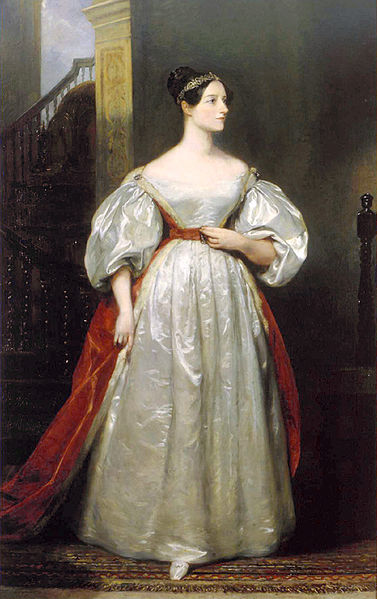
Ada Lovelace

To learn more: